
We recognise that water is the lifeblood of the South East’s livestock economy.
Following lessons learned from previous supply incidents, we’ve formalised a new policy to provide dedicated support for farmers and commercial livestock owners during unplanned water supply interruptions.
As part of this, we’re committed to going above and beyond our statutory obligations, recognising the importance of the livestock sector in the south east.
We outline the support we will be offering below, please familiarise yourself with this information before signing up.
It’s important all livestock owners register with us so we can provide them with the most appropriate support.
Livestock owners can register here .
Our commitment to you
Holdings with six or more animals:
During an unplanned interruption, we will use reasonable endeavours to provide alternative water to those who have a minimum of six livestock animals through:
- Bottled water: For critical immediate needs, primarily for young or vulnerable animals, where appropriate and feasible.
- Bowsers: Mobile water tanks to deliver bulk water to accessible locations.
- Static tanks: Temporary fixed tanks deployed at strategic points for ongoing supply.
- Tanker deliveries: Direct delivery of bulk water by tanker to on-farm storage, if suitable access is available.
We aim to deploy this support within 48 hours of an interruption beginning, prioritising areas with the highest animal welfare risk.
Holdings with five or less animals:
For those livestock owners with five or less animals, we will provide:
- Livestock filling point: Livestock filling points will be established to facilitate the collection of bulk supplies and bottled water.
Eligibility and criteria

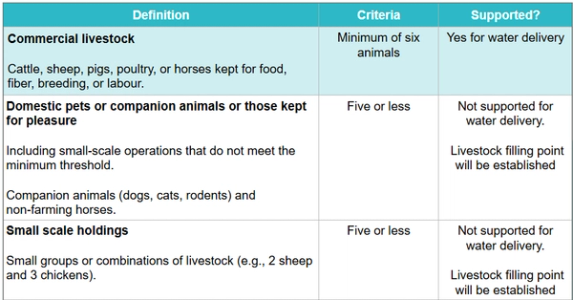
To ensure our resources are directed where they are most needed, support is strictly limited to commercial livestock operations, registered smallholdings and those with non-farm animals such as horses.
Legal Note: Under the Animal Welfare Act 2006, the legal responsibility for contingency water supply for pets and companion animals rests entirely with the owner.
Practical solutions and tips
Our primary aim is to protect the stability of the agricultural sector and large-scale animal welfare. By focusing our bulk emergency equipment, such as 30,000-litre tankers, on commercial livestock operations, we can move the largest volumes of water to where the need is most critical for the food chain and animal health.
Smaller holdings require far less water than larger holdings and water can be transported far more independently, ensuring specialist key resources can focus on maintaining larger livestock operations.
- Lower total volume: A small group of five animals typically requires 18 to 600 litres per day, depending on the species. This amount fits easily into common Intermediate Bulk Containers (IBCs) or small bowsers.
- Standard transport: You can transport these quantities using a standard pickup truck or a trailer with a 1,000-litre IBC’s, which is much more accessible than a professional water tanker.
- Simple storage: A single 1,000-litre tank can provide reserves of up to five days for six animals, depending on their size.
- Manual filling: In extreme cases, 200 to 400 litres can be moved manually with 20-litre buckets or five-gallon jugs, which is physically possible for a small number of animals but impossible for a large herd.
How we developed this policy
During a water supply interruption, we are bound by our licence terms, which stipulate that we prioritise alternative water provision for human consumption first, as well as Tier 1 priority locations such as hospitals or prisons.
We are funded for this through the price review process and have recently invested in additional capacity, including a fleet of 12 tankers, dedicated drivers and a full-time response team.
Our licence terms and the funding we receive through the price review process do not currently allow the company to supply alternative water to livestock during a supply interruption.
We recognise this gap, so we have worked closely with stakeholders from DEFRA, the NFU, and colleagues at other water companies to develop this framework. Our primary aim is to ensure what we offer is deliverable and support the regional economy. We believe this policy significantly advances how we can support the agricultural community during a water supply interruption.
Resilience and contingency planning
It is essential to note that under The Welfare of Farmed Animals (England) Regulations 2007, the primary legal responsibility for ensuring animals have constant access to water lies with the owner.
We urge all livestock owners to:
- Ensure they have robust contingency plans in place.
- Maintain adequate on-farm storage.
- Explore rainwater recycling and water reduction as part of our 25 Year Environment Plan(opens in a new tab).
How to register for support
To receive support, livestock owners must register their details with us. You DO NOT need to provide your Single Business Identifier (SBI) if you don’t have one.